HOW REMOVAL WORKS

Every tattoo is unique. Before treatment, we evaluate several factors, including:
- Tattoo size
- Ink colors
- Tattoo age
- Professional or amateur application
- Skin type
- Tattoo location
- Previous removal attempts
- Your treatment goals
This allows us to develop a personalized treatment plan and provide a realistic estimate of the number of sessions you may need. During your treatment, carefully selected laser energy passes safely through the outer layer of your skin and specifically targets the tattoo pigment beneath the surface.
Different wavelengths of light target different ink colors. Because each color absorbs light differently, certain colors may respond faster than others.

The laser delivers extremely short, high-energy pulses that shatter the tattoo pigment into much smaller particles.
Think of it like breaking a large rock into tiny pieces.
The laser doesn't remove the ink itself, it simply makes the particles small enough for your body's natural immune system to begin clearing them away. After your treatment, your immune system begins carrying away the fragmented ink particles through your body's natural healing process.
This is why tattoo removal continues even after you've left the office.
Many clients notice their tattoo fading for several weeks following each treatment.

Your skin needs time to recover, and your body needs time to remove as much fragmented ink as possible.
For this reason, treatments are typically spaced several weeks apart.
Proper healing between sessions often produces better long-term results than treating too frequently. Every session removes additional pigment.
Some tattoos respond quickly, while others require additional treatments.
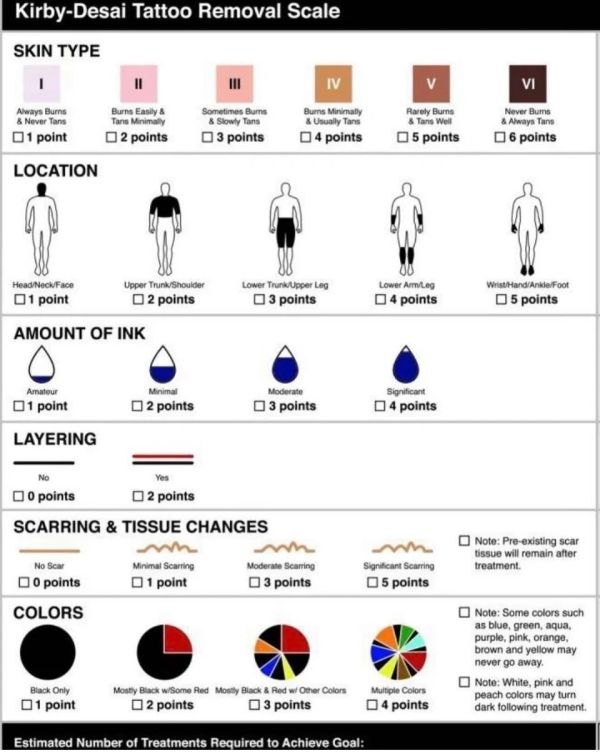
We use the Kirby-Desai Scale, a widely recognized tattoo-removal assessment tool, to help estimate the number of treatments that may be needed. The scale considers several factors that can influence removal, including skin type, tattoo location, ink color and density, scarring or tissue changes, and the amount of ink present.
At Overhaul Studio, treatments are performed using the Candela PicoWay® picosecond laser, an advanced technology designed to break tattoo ink into extremely small particles using ultra-short pulses of energy. Picosecond technology may allow for more efficient ink clearance and potentially fewer treatments than older laser technologies.
The Kirby-Desai Scale provides an estimate, not a guarantee. Every tattoo and every person's response to treatment is different, and complete tattoo removal can never be guaranteed. During your consultation, we'll evaluate your tattoo individually, discuss a realistic treatment range, and track your progress throughout the removal process.